The section “Regional economics” analyzes key trends in the economic development of the Northwestern Federal District in the context of unprecedented sanctions pressure that began in 2022, examines methodological approaches to studying the socio-economic genotype and applied aspects of its use in the context of regional development, and raises the issue of empirical assessment of the impact of the agglomeration effect on the demographic dynamics of peripheral settlements.
The subject of study and analysis in the section “Branch-wise economics” has become the spatial reconfiguration of flows within the supply chains of the Russian ferrous metallurgy industry under the influence of new geopolitical shocks and challenges, the creation of an agrobiotechnopark as a key element of technological modernization of the agro-industrial complex and the formation of an export-oriented model of subtropical crop production, assessment of the differentiated impact of sanctions on the socio-economic development of dairy cattle breeding, taking into account the adaptation mechanism in the region.
The section “Social and economic development” is devoted to the relationship of subjective status with the level of consumption and the amount of property in modern Russian society, informal employment, the impact of the employment digitalization on parental strategies, and testing the hypothesis of the environmental Phillips curve for Russia.
In addition, the pages of the magazine identify the importance of culture and traditions for the territories’ development in key projections of the integration of culture with tourism and the production of unique products with cultural, historical and artistic value, using the example of Russia and China. It is presented the results of monitoring public opinion on the state of Russian society.
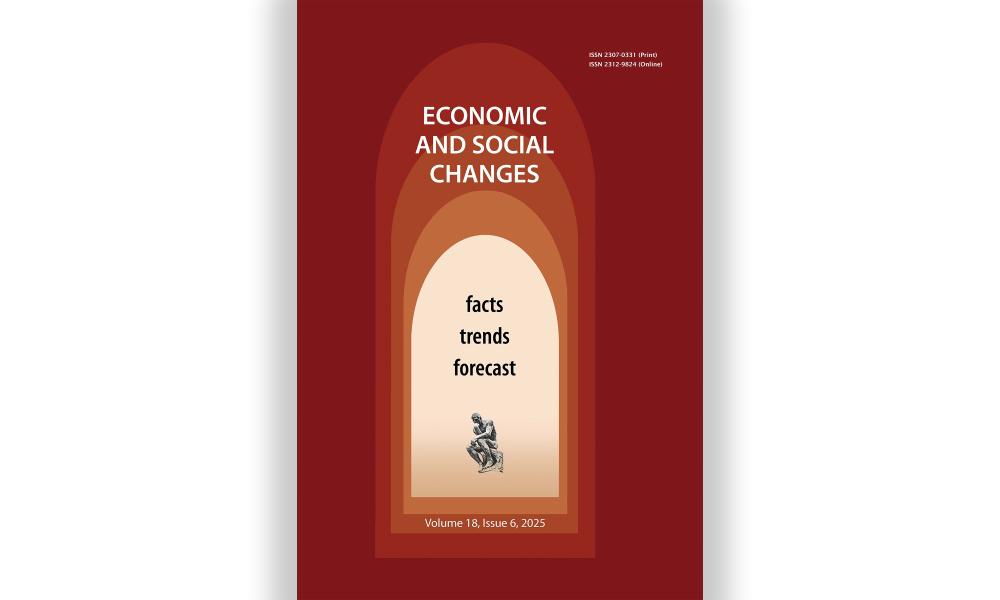
The journal was founded in 2008, and its founder is Vologda Research Center of RAS. The publication has been assigned category K1 in the List of the Higher Attestation Commission; it is included in the first level of the Unified State List of Scientific Publications (“White List”). The English-language version of the journal has been published since 2009 and is registered with the ISSN International Center (No. 2307-0331).
The issue opens with the article “What kind of state do Russian want to live in? What kind of state has been built?” by RAS Corresponding Member, Doctor of Sciences (Economics), Professor, Honored Scientist of the Russian Federation V.A. Ilyin, Candidate of Sciences (Economics), Senior Researcher of VolRC RAS M.V. Morev, which examines the problem of practical realization of the desired image of the future of Russia for the majority of citizens. Its relevance is shown before and after the start of a special military operation in Ukraine. Based on Russian and regional sociological research, as well as expert assessments, it is concluded that for most people the desired image of Russia's future is a strong, sovereign country based primarily on traditional values (among which social justice is of key importance) and the values of a welfare state, which generally corresponds to the course of national development being implemented by the President of the Russian Federation Vladimir Putin for the previous 25 years.
The journal discusses the adaptation of Russian ferrous metallurgy supply chains to geopolitical challenges, the role of socio-economic genotype in shaping regional development strategies, the prerequisites for creating an agrobiotechnopark as an element of innovative infrastructure, the sustainable development of dairy farming in Russian regions under sanctions, and the impact of the employment digitalization on parental strategies.
These topics are covered in detail in articles by leading experts on the analysis and forecasting of changes in the economy and social sphere of various countries, regions, and local territories:
“Trends in the Economic Development of Russia’s Northwest Regions: A Structural Approach to Monitoring” by E.V. Lukina, Cand. Sci. (Econ.), Senior Researcher, VolRC RAS and M.N. Rumyantseva, Senior Researcher, VolRC RAS (Vologda);
“Improving the Population’s Quality of Life: The Role of the Socio-Economic Genotype in Shaping the Regions’ Development Strategy” by P.A. Kaisina, Assistant Professor of Department of Economic and Financial Strategy, Moscow School of Economics, Lomonosov Moscow State University; M.V. Shakleina, Cand. Sci. (Econ.), Associate Professor, Moscow School of Economics, Lomonosov Moscow State University; S.V. Svetlichnaya, Cand. Sci. (Ped.), Head of Department of Social Welfare, Promsvyazbank PJSC (Moscow);
“The influence of the Agglomeration Effect on the Demographic Policy of Territories” by A.M. Sitkovskiy, Researcher, FCTAS RAS; A.E. Raisikh, Junior Researcher, FCTAS RAS; A.S. Gladky, Cand. Sci. (Geogr.), Leading Researcher, FCTAS RAS; N.A. Bezverbnaya, Cand. Sci. (Soc.), Leading Researcher, FCTAS RAS (Moscow);
“Adaptation of Russian Ferrous Metallurgy Supply Chains to Geopolitical Challenges: From Reorientation of Flows to Changes in Financial Results” by S.P. Petrov, Cand. Sci. (Econ.), Associate Professor, Institute of Economics and Industrial Engineering, Siberian Branch of RAS (Novosibirsk); M.A. Pechenskaya-Polishchuk, Dr. Si. (Econ), Associate Professor, VolSC RAS (Vologda);
“Prerequisites for the Creation of an Agrobiotechnology Park as an Element of Innovative Infrastructure” by S.G. Pyankova, Dr. Sci. (Econ.), Professor, USUE (Yekaterinburg), B.V. Makarenko, Deputy General Director, LLC RFA, Deputy General Director, AO GC Talent (Sochi);
“Problems of Sustainable Development of Dairy Cattle Farming in Russian Regions under Sanctions” by O.V. Takhumova, Cand. Sci. (Econ.), Associate Professor, KubSAU named after I.T. Trubilin; I.A. Bursa, Dr. Sci. (Econ.), Professor, KubSAU named after I.T. Trublina (Krasnodar);
“Subjective Social Status of Russians: Relationship with Property Characteristics” by N.D. Kolennikova, Cand. Sci. (Soc.), Senior Researcher, Institute of Sociology, FCTAS RAS (Moscow);
“Informal Employment: Problems of Work-Life Balance” by E.A. Chernykh, Cand. Sci. (Econ.), Leading Researcher, Center for Human Development, Institute of Economics, RAS (Moscow), N.V. Korovkina, senior lecturer, UUST (Ufa), G.V. Leonidova, Cand. Sci. (Econ.), Leading Researcher, VolRS RAS (Vologda);
“The Impact of Employment Digitalization on Parenting Strategies” by N.V. Tonkikh, Cand. Sci. (Econ.), Associate Professor, USUE, S. V. Begicheva, Cand. Sci. (Econ.), Associate Professor, USUE, T. A. Kamarova, Cand. Sci. (Econ.), Associate Professor, USUE (Yekaterinburg);
“The Environmental Phillips Curve Hypothesis for Russia: The Relationship between the Levels of Environmental Pollution and Unemployment” by F. Akin, Associate Professor, Erzincan Binali Yildirim University, F. Ozgun, Associate Professor, Istanbul Yeni Yuzyil University (Turkey);
“Culture and Traditions as Drivers of Territorial Development: The Experience of Russia and China” by A.A. Shabunova, Dr. Sci. (Econ.), Associate Professor, Director, VolRC RAS (Vologda), Gan Genhua, Bachelor, member of the Leading Party Members’ Group, Vice-President, Jiangxi Academy of Social Sciences, Director, Jiangxi Institute of Local Records, Chairman, Jiangxi Association of Local Records (China), O.N. Kalachikova, Cand. Sci. (Econ.), Leading Researcher, VolRC RAS (Vologda);
“The Logic of Development of Civil Society Studies at VolRC RAS” by K.E. Kosygina, Cand. Sci. (Econ.), Leading Researcher, VolRC RAS, T.A. Guzhavina, Cand. Sci. (Phil.), Leading Researcher, VolRC RAS (Vologda);
“Interdisciplinary Intersections of Research on the Determinants of Aging” by O.A. Basheva, Cand. Sci. (Soc.), Leading Researcher, Institute of Sociology, FCRAS RAS, Senior Researcher, Lobachevsky SUNN (Reutov), E.F. Chernikova, Cand. Sci. (Med.), Senior Researcher, NNSRIHOD of Rospotrebnadzor, Senior Researcher, Lobachevsky SUNN (Nizhny Novgorod), M.V. Vedunova, Dr. Sci. (Bio.), Professor, Lobachevsky SUNN (Nizhny Novgorod).
The issue of the magazine traditionally ends with the section “Monitoring studies”. It reflects the dynamics of a number of parameters of social well-being and socio-political sentiments of the region's population based on the results of the last “wave” of monitoring (December 2025), as well as for the period from December 2024 to December 2025 (the last 7 surveys, that is, the year of measurements). The research results are compared with the average annual data for 2000 (the first year of the first presidential term of V.V. Putin), 2007 (the last year of the second presidential term of V.V. Putin, when the highest ratings of presidential activity were achieved), 2012 (the first year of the third presidential term of V.V. Putin), 2018 (the first year of the fourth presidential term), 2023 (the last full year of the fourth presidential term).
The articles in this issue will be of interest to members of the academic and expert community, university faculty, public and municipal authorities, business representatives, and all those interested in economic and social development.
Full-text versions of he articles in the current issue can be accessed on the journal website.